
Engineering Trust in AI for Physical Systems
Exploring trust, autonomy, and governed intelligence in physical-world systems, buildings, infrastructure, and operational platforms.
AI capability is advancing rapidly. Safe execution is not keeping pace.
AI is increasingly asked to interpret and act in environments that are only partially understood.
Most systems can interpret. Few can act safely.
The gap between inference and unvalidated physical action is where risk emerges.
Start with the executive briefing, then explore the full model in detail.


Governance
at the Boundary
Establishing trust boundaries where AI systems interact with the physical world.

Autonomy
Tier Model
A tiered approach to autonomy based on operational context and risk.
Systemic
Risk Lens
Identifying and managing emergent risk across interconnected systems.

Platform
Implications
Designing infrastructure and policies that enable safe, scalable, and responsible deployment.
A Framework for Trustworthy AI in Physical Systems
Problem → Governance → Autonomy → Platform
AI was designed for digital environments.
Trust must be engineered for operational infrastructure.
Problem:
Every system holds a fragment of operational truth. None preserve the continuously governed context required for AI to act safely across changing physical environments.
Digital systems operate inside defined logic. Physical systems operate inside changing conditions, hidden dependencies, and real-world consequences.
Most AI architectures were built for information environments, not operational infrastructure.
Governance:
Trust Boundaries establish the conditions under which reasoned intelligence can safely interact with buildings,
infrastructure, and operational systems.
They create machine-enforceable constraints between AI inference and operational actions.
Autonomy:
Autonomy in physical systems is not simply automation.
It requires validated context, bounded execution, and continuous alignment to operational reality.
Platform:
Current and future platforms must support both digital intelligence and physical accountability.
This requires infrastructure that understands context, constraints, and governed AI execution.
Each section explores one layer of the transition from digital intelligence to trustworthy
operation in physical environments.
The Trust Boundary Model
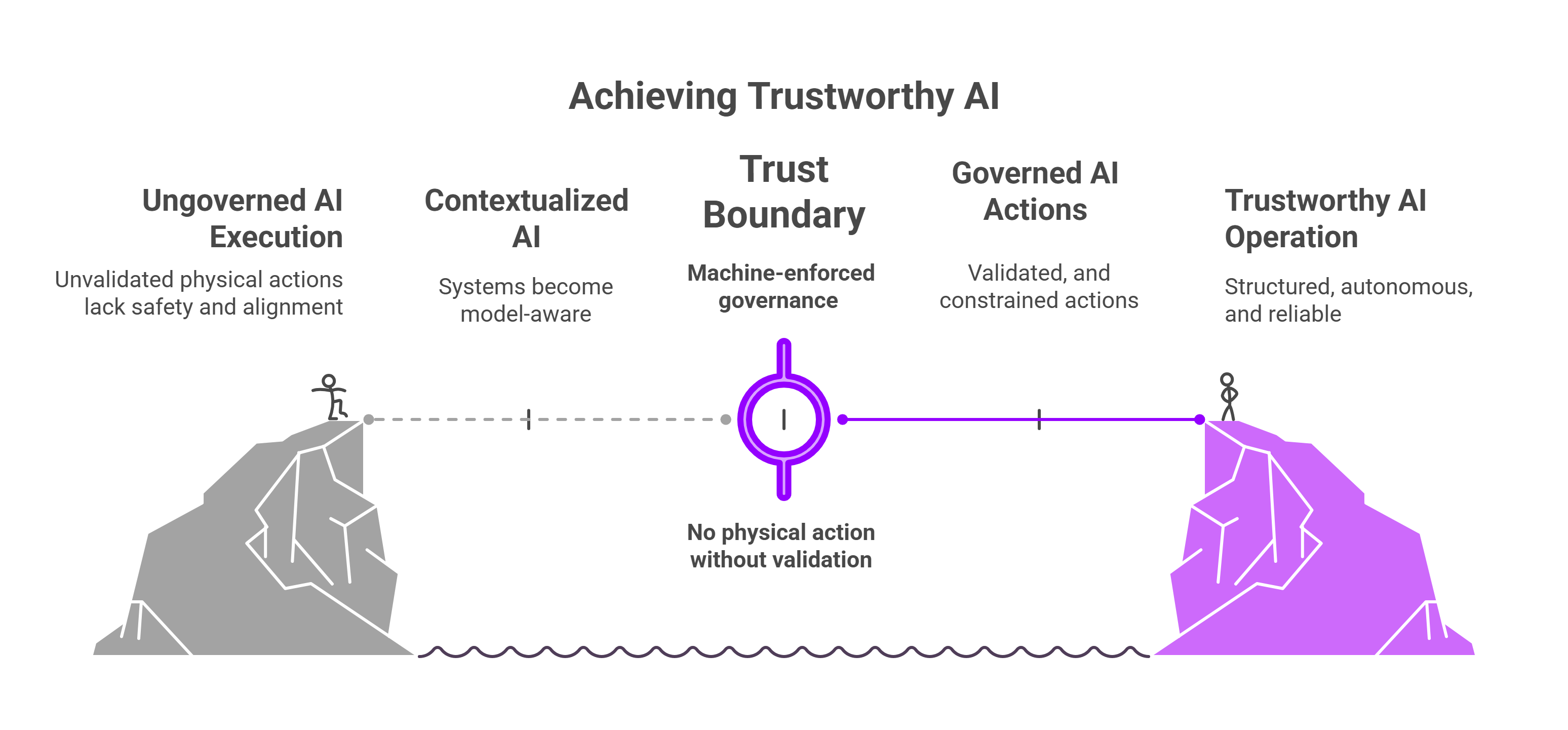
Trustworthy AI is not achieved through better models alone.
It requires a control layer that governs how AI interacts with real systems.
Autonomy Tier Model
Progression through the tiers is not a technology upgrade. It is a governance upgrade.
The Autonomy Tier Model shows how execution authority evolves, and where machine-enforceable governance becomes essential.
Systemic Risk at Scale
As AI moves from recommendation to execution, risk itself changes in nature and scale.
Failures that were once localized become systemic events that propagate through physical systems with inertia and irreversible outcomes.
Platform Implications
Observation is no longer enough.
The next phase of AI in buildings will not be won by the organizations with the most models. It will be won by the organizations with the most trustworthy operational architecture.
Where Existing Architecture Breaks
AI systems today can detect patterns, generate insights, and recommend actions.
They are increasingly embedded in environments where those actions influence real systems.
Most architectures do not enforce how those actions are executed. AI outputs can influence physical systems without validation against semantic understanding or operational constraints.
This creates a structural gap between inference and execution.
In physical systems, this is where risk emerges.
Governance cannot remain external.
Trust must be engineered.
The Trust Boundary Defines Control
The trust boundary introduces machine-enforced governance at the point where digital decisions become physical actions.
Every proposed action is validated before execution. Inputs are interpreted within structured semantic models, validated against operational constraints, and either authorized or rejected.
No physical action occurs without validation.
This transforms AI from an interpretive system into a governed operational system.
Physical Systems Operate Under Constraints
Physical systems operate under real-world constraints:
- “Safety-critical dependencies”
- “Interconnected system behavior”
- “Irreversible outcomes”
In these environments, errors do not degrade results. They propagate into the real world.
AI must operate within enforceable constraints, not inferred understanding.
Trust becomes actionable through a defined system architecture.
The Trust Boundary System
The Trust Boundary becomes actionable through a defined system architecture.
This architecture is composed of four integrated components:
- Autonomy Tier Model
Defines how execution authority evolves and where governance becomes critical
->Explore the Autonomy Tier Model - Systemic Risk at Scale
Explains how failure behavior changes as systems begin to act
->Explore Systemic Risk at Scale - The Trust Boundary
Establishes the machine-enforceable control layer at the point of execution
->Explore the The Trust Boundary - The Trust Boundary Stack
Defines how semantic context, enforcement, and commissioning operate together
->Explore the Trust Boundary Stack
From Insight to Governed Execution
With a trust boundary in place, AI systems transition from ungoverned execution to structured autonomy.
Actions are validated, constrained, and aligned with real-world conditions.
Systems move from reactive outputs to governed execution.
This establishes a new class of operational infrastructure for physical systems.
The full framework, architecture, and maturity model are detailed in the whitepaper.
What Comes Next
“Featured in IFMA FMJ: From Dashboards to Governed Autonomy”
Read the article → link to FMJ article
Phase 1
Public Framework
Establishing a shared language for trustworthy AI in operational infrastructure.
Phase 2
Applied Exploration
Selective advisory, architecture discussions, and early-stage implementation in real-world systems.
Organizations are beginning to move beyond AI experimentation toward governed, operational deployment.
Ready to Apply This Framework?
The next step is not more analysis. It is applying governance, architecture, and operational constraints to real systems.